Hacker News
Mixing Visual and Textual Code
kitd
|next
[-]
It was pretty cool in principle but nearly unworkable in practice, purely because maintaining an ascii diagram in a text editor for anything more than "Hello world" is a massive PITA.
The simple text editor has a lot to answer for when it comes to how we think about programming, in a Sapir-Whorf kind of way. It's a shame there has been no cast iron standard for mixing live text and visuals. Our industry might look very different.
Towaway69
|root
|parent
[-]
I wonder whether those that used punch cards said the same about those punch cards?
It’s weird how our mobile devices aren’t programmed using keyboards/text as input devices. Or our microwaves. Or refrigerators.
Programmers are stuck with text because their programming paradigms are stuck in a text-based paradigm, hence AIs spew out reams and reams of simple to understand text.
There is definite room for improvements and room for keyboards. However the focus should move on from keyboard to mouse to XR environments using 3D glasses. Our programming paradigms have to move aswell.
Using a visual first paradigm means using higher level constructs, things such as Blockly from Google isn’t a good example of visual programming. For music, things such as noisecraft are. For more general programming approach, Node-RED is a good example of visual programming based on flow based programming paradigm which is well suited to visual programming.
varjag
|root
|parent
|next
[-]
As a small challenge you could try expressing the contents of your comment using visuals only.
Joker_vD
|root
|parent
|previous
[-]
Oh, absolutely. One statement/line per card, the first 5 columns reserved for labels (how's that for significant whitespace?), the 6th to signal line continuation, the last eight for arbitrary comments/line numbers? People loathed it.
kitd
|root
|parent
[-]
A visual programming canvas is free of that, and thus can display connections and relationships far more deeply and conveniently than text-based languages.
It's the 2D nature of our languages that has a lot to answer for.
Izkata
|next
|previous
[-]
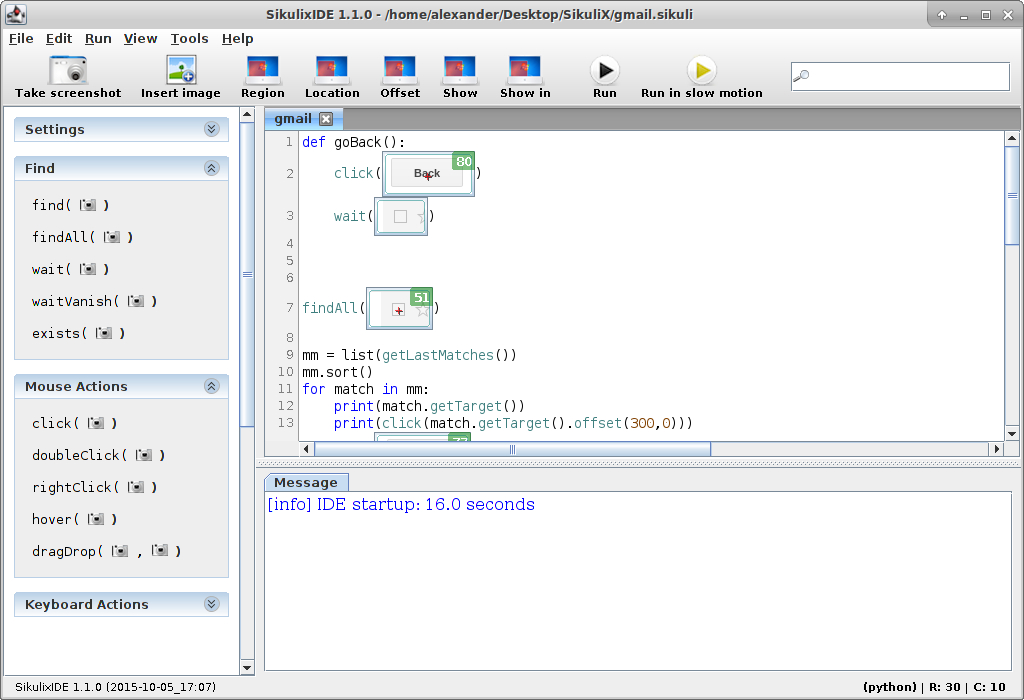
The language was just python and the IDE swapped out certain functions' arguments with the image and targets within the image that the code referred to. It also had a bunch of built-in functionality that let you manipulate the images and targets (the little red crosses in that screenshot) directly within the IDE instead of having to edit the underlying python code.
Looks like it has a successor called Oculix but I know nothing about that.
WillAdams
|next
|previous
[-]
Looking forward to reading the paper and hope that it is widely read/discussed, and that it influences projects/developers such as: https://www.inkandswitch.com/
I'd dearly love to see a 3D CAD program which used this methodology.
donaldihunter
|next
|previous
[-]
Modern collaborative visual tools like Miro sidestep the concurrent development problem by being live multiplayer and by essentially having no version management at all.
Most visual BPM tools that I'm aware of try to mix flowchart style programming with e.g. Javascript on activity nodes, but they fail provide any developer-time syntax checking or completion. They also tend to serialise to XML which is unworkable in practice for diff/merge of the visual logic.
In a previous job we developed an in-house flowchart based language that embedded Javascript. We put the effort into writing a first-class Eclipse plugin that had syntax checking and completion across all graphical and Javascript constructs. It even had interactive debugging that interleaved graphical and textual single-stepping. We never solved the diff/merge problem in a satisfactory way.
james_ross
|root
|parent
[-]
Prepare Meal is a Process Oven enables Prepare Meal Utensils enable Prepare Meal Prepare Meal transforms Raw Ingredients Prepare Meal produces Finished Meal Menu governs Prepare Meal Customer Order governs Prepare Meal
You can map out a business process using a very simple (and XML-free, and diffable) plain text DSL and generate interactive diagrams from it. My most recent example is for concept maps along similar lines.
Garlef
|next
|previous
[-]
Maybe the authors should just vibe code a cljs port and put it in a browser?
And showcase some program written in this language that sells it better?
donaldihunter
|root
|parent
[-]
https://new.observablehq.com/@observablehq/notebooks-2-0-sys...
doctorhandshake
|next
|previous
[-]
gr__or
|next
|previous
[-]
I'm working on a similar idea, it's been a while since I published about it but open to input and collabs!
summarybot
|next
|previous
[-]
michael-ax
|next
|previous
[-]
conartist6
|previous
[-]
whatever1
|root
|parent
|next
[-]
Now it does not matter anyways. We are not reading/ writing code anymore. Just specifying it and testing it.
brookst
|root
|parent
|next
[-]
But I drive grasshopper with Claude code, so still 100% agree with your last graf.
conartist6
|root
|parent
|next
|previous
[-]
Anyone who thinks code doesn't matter anymore is selling something. Trying saying "math won't matter anymore" while clicking your heels three times
binary0010
|root
|parent
|previous
[-]
So I feel like your last sentence doesn't really track - yes they are like you , just telling specifications to the machine, but they can struggle for hours trying to get those specific instructions right because they can't understand what their systems are doing.
lukan
|root
|parent
|previous
[-]
conartist6
|root
|parent
|next
[-]
BABLR is just the extensible streaming parser framework, but it has a few key things going for it: 1. Gap support like Hazel has, but for any language it can parse 2. Streaming parse results, which make multi-pass stream transformation easy 3. The ability to consolidate and take over the work currently done by Treesitter, LSP, Git, and the IDE itself.
lukan
|root
|parent
|next
[-]
"BABLR is a parser framework roughly comparable to Tree-sitter, but built from the ground up for the web"
I have to admit, I don't know why I would stop using my wasm build of treesitter that works amazing on the web for something that is "conditionally production ready". Also I don't see where your project mixed visual and textual code like this paper here explores?
IshKebab
|root
|parent
|previous
[-]
conartist6
|root
|parent
[-]
IshKebab
|root
|parent
[-]
conartist6
|root
|parent
|next
[-]
If your solution to global problems is for everyone in the world to adopt Hybrid Clojure Script as their programming language, you don't really have an economically viable solution.
IshKebab
|root
|parent
[-]
> I think they may fall over in surprise when they realize that this technology become commercially viable while they were busy writing this academic paper...
"this technology" is an actual concrete language that mixes text and graphics. Not a version control system or an extensible parser framework or whatever it is that you have.
Maybe one day you will build an actual language that mixes text and graphics but unless you can show me a screenshot of that it seems like a dick move to say that they've wasted their time because you've already got a commercially viable version, when actually you haven't at all.
Chu4eeno
|root
|parent
|previous
[-]
(It's the only programming language with inline graphics I can think of, at least, your average esoteric visual language tend to not mix with normal code.)
voidUpdate
|root
|parent
|next
[-]
conartist6
|root
|parent
[-]
This academic paper assumes two largely unmixed disciplines just barely kissing each other. I see a complete blending coming that will melt the boundaries between textual and visual programming.
Once you start thinking like this, you stop seeing semantic editing as a feature of a particular language: it should just be a native ability to have on any parseable code: the ability to reassemble the parse tree nodes like lego bricks.